版木The block, carved in reverse, is inked
The press is printing it. Rub the sheet to print it yourself.
Scroll to pull the sheet off
Move the lamp across the paper
Pull the carpenter’s line and let it go
Touch the river
Hold to carve the oar
Press and hold to draw. Let go inside the red, when his blade flashes.
目録The five scrolls, and the places on his road
地之卷 The first scroll
Earth: the lay of the land.
Ishikawa Ryūsen, Nihon kaisan chōriku zu, a map of Japan, Edo, 1691: cut on blocks, coloured by hand. National Diet Library. Printed again here from its own blocks.
生國播磨の武士新免武藏藤原玄信
“A warrior born in Harima: Shinmen Musashi, Fujiwara no Genshin.”
How the book begins. He gives his province before his name.
Utagawa Hiroshige, Harima: Maiko Beach, from Famous Places in the Sixty-odd Provinces, 1853. National Diet Library.
“It levels the ground for a straight road, so the first scroll is called Earth.”
Go Rin no Sho, the Earth scroll
Hiroshige drew this coast of Harima two hundred years after him, for a series he called Sixty-odd Provinces.
Sixty-odd provinces, Hiroshige wrote. Sixty-odd fights, Musashi wrote. The same character: 餘.
六十餘度
六十餘度迄勝負をするといへども、一度も其利を失はず
記 The record, in his own hand
More than sixty times I fought, and not once did I lose.
The book begins with a count. He names the fights he thought worth naming, by his age, and then the total: all of it between thirteen and twenty-eight or twenty-nine.
Go Rin no Sho, the preface, 1643
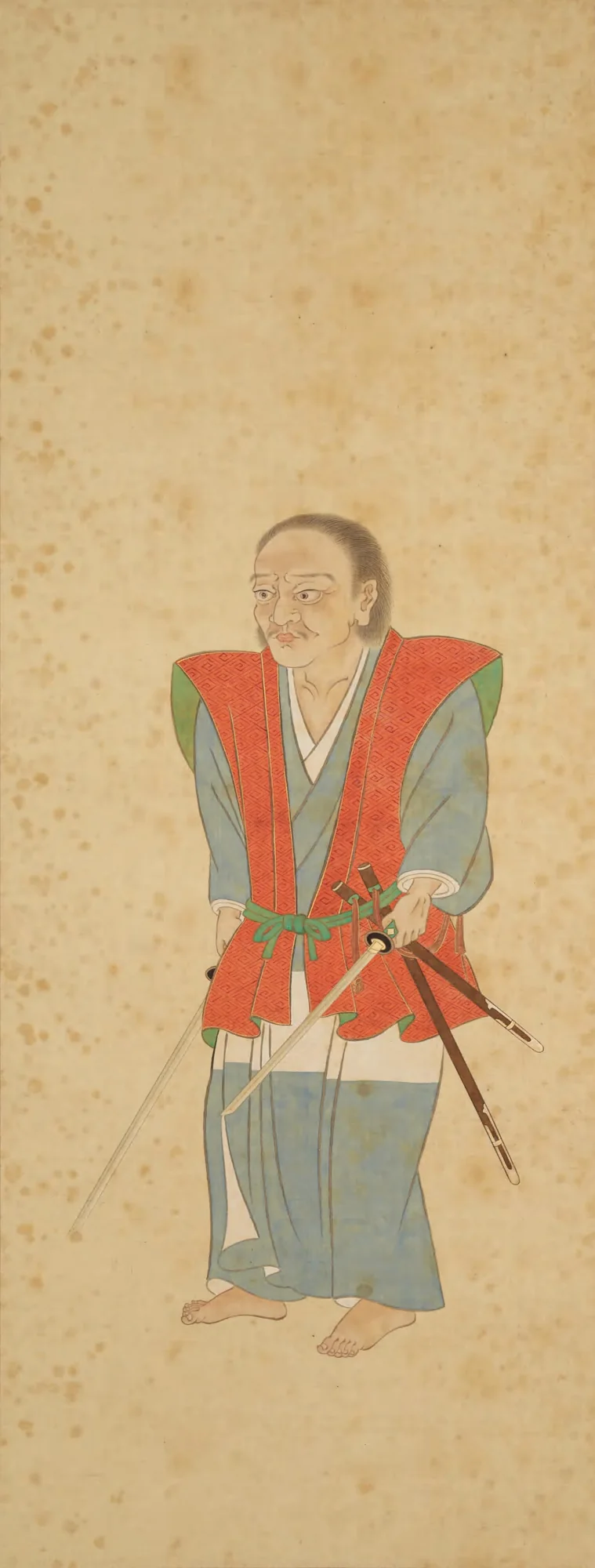
像 His face
Two swords held low, the points down. Barefoot.
Who painted it is not known; it has long been called his own hand. The prints that follow in this book were made two hundred years after him.
宮本武蔵自画像, a portrait of Miyamoto Musashi, said to be by his own hand. Ink and colour on paper. Imperial Household Agency, Archives and Mausolea Department.
我三十を越えて跡を思ひ見るに、兵法至極して勝つにはあらず
省 Then he takes his own record apart
“Past thirty, looking back, I saw that I had not won because I had mastered strategy.”
Perhaps a natural gift, he writes, or the other schools were weak. He went on training morning and night, and came to the Way at about fifty.
兵法を大工の道にたとへて云ひあらはすなり
墨 The carpenter
“I speak of strategy by likening it to the way of the carpenter.”
A master carpenter sets out the whole house with his square and his ink line before a single post goes up. The Earth scroll is that plan.
水之卷
The second scroll
Water
水を本として心を水になすなり
“Take water as the root: make the mind water.”
The scroll of the body: the stance, the grip, the gaze. Tajima, then Kyoto.
Utagawa Hiroshige, A Sudden Shower at Tadasu Riverbank, from Famous Places in Kyoto, c. 1834. National Diet Library.
“Water takes the shape of its vessel, square or round. It becomes one drop; it becomes the blue sea.”
Go Rin no Sho, the Earth scroll, on Water
The Kamo river at Tadasu, in the north of the city, where Rendaino and Ichijōji lie: the fields of the Yoshioka fights.
吉岡
京 Kyoto, at twenty-one
The house of Yoshioka
The book only says “the swordsmen of the realm”. The stone his adopted son Iori raised in 1654 names them: the Yoshioka, sword teachers to the shoguns.
清十郎
一 The heir
Seijūrō, the heir, outside the city. One blow of a wooden sword; he lived, gave up the art and cut his hair.
傳七郎
二 The brother
Denshichirō, his brother, came with a wooden sword over five shaku long. Musashi took it from him and struck him dead with it.
下り松
三 The house
Sagarimatsu, the hanging pine. The house’s pupils came for him there, “several hundred”, with arms and bows. He scattered them.
Kokura stele, 1654, as read by Fukuda Masahide. Later Yoshioka accounts call it a draw.
一命を捨つる時は、道具を不殘用に立て度きものなり
二刀一流 Two swords, one school
“When you give up your life, you want every one of your weapons to have been used.”
A warrior wears two swords; dying with one still in the sash makes no sense, he writes. So learn to hold the long sword in one hand. “In this school you win with the long, and you win with the short.”
觀の目つよく、見の目よわし
目 The gaze
The eye that perceives, strong. The eye that looks, weak.
See the far as near and the near as far, he writes; know the enemy’s sword without looking at it. Whatever you look at here goes soft. Look at nothing and you see all of it.
千日の稽古を鍛とし萬日のけいこを鍊とす
鍛鍊 Forging and polishing
0days of practice is forging,
0days is polishing.
火之卷
The third scroll
Fire
火は大小に成、けやけき心なるに依て合戰の事を書くなり
“Fire grows large and grows small, and it is fierce; so in this scroll I write of the fight.”
One man against one man, ten thousand against ten thousand: the same Way, he writes.
Ryūsen’s map draws the road west along the Inland Sea, to the strait between Honshū and Kyūshū.
Utagawa Hiroshige, Nagato: Shimonoseki, 1856. National Diet Library.
“Crossing at a ford: when you cross the sea, there are straits.”
Go Rin no Sho, the Fire scroll
On the way over to the island, the later biographies say, he cut a wooden sword from an oar.
Utagawa Yoshifusa, The duel at Ganryūjima, triptych, 1840s–50s. Musashi at the centre, Ganryū at the right, the crowd on the shore and in the boats.
又大き成る太刀を好む流有り、戰兵法よりしては是を弱き流と見立つる也
“There are schools that love the long sword. As I see strategy, these are weak schools.”
Go Rin no Sho, the Wind scroll
武蔵、木刃の一撃を以て之を殺す。電光も猶遅し
“Musashi killed him with one blow of a wooden blade. Lightning would have been slow.”
The Kokura stele, 1654
岩流嶋 Ganryū’s island, as it was told
Musashi never wrote about the island. Everything we know was written after he died, and each retelling added a block of colour, the way a print gains its blocks.
- 1654The key blockThe Kokura steleRaised by his adopted son Iori, forty-two years on. A master named Ganryū, a white blade three shaku long against a wooden one, one blow. “So people renamed Funashima: Ganryū’s island.” It gives no date.
- 1672Two more blocksThe Numata family recordFrom the house of the castellan of Moji: Musashi crossed with pupils; Ganryū came alone.
- 1716FourBukan kanjōkiThe oar. Two wooden swords cut from it, two shaku five sun and one shaku eight sun, against a sword of more than three shaku.
- 1737SixA kabuki play, OsakaKatakiuchi Ganryūjima. After it, Ganryū is called Sasaki.
- 1776Full colourNitenkiBy Toyota Kagehide, of Musashi’s own school, from the Bukōden of 1755: Keichō 17, the fourth month, the thirteenth day; Musashi late; the boatman. The date everyone gives now is this one. Other lines of his school put the fight in 1601 or 1602.
1/ 37
Scroll, or drag the pile, to lift the volumes off
風之卷
The fourth scroll
Wind
風と云に於ては、昔の風今の風其家々の風抔とあれば
“By wind I mean the styles of old, the styles of now, the styles of each house.”
His Wind scroll reads the other schools. This one reads the others reading him: after he died, the story kept travelling.
Utagawa Kuniyoshi, Miyamoto Musashi attacking the giant whale, triptych, published by Kawaguchiya Shōzō, 1847–50.
The Wind scroll is his reading of the other schools. This chapter is the other way round: how the other houses drew him.
A whale off the coast, the size of a hill, and one man standing on its back, driving his sword in. Three of Kuniyoshi’s sheets, edge to edge.
The print shop’s line
The legend, for sale
Kuniyoshi and Yoshitoshi gave Edo a Musashi who fought monsters. Drag to blow through the line; pick a sheet to take it down.
- 1935–39吉川英治『宮本武蔵』Eiji Yoshikawa’s Musashi, a serial in the Asahi Shimbun. It gave him Otsū and the monk Takuan, and much of what people now think they know about him.
- 1954–56稲垣浩・三船敏郎Hiroshi Inagaki’s Samurai Trilogy, Toshiro Mifune as Musashi. The third film is Duel at Ganryu Island.
- 1998井上雄彦『バガボンド』Takehiko Inoue begins Vagabond, from Yoshikawa’s novel, in Kodansha’s Morning. He drew it, in the end, with a brush.
バガボンド Vagabond, by Takehiko Inoue
From 3 September 1998 in Morning, Kodansha. Based on Yoshikawa’s novel.
Grand Prize, Japan Media Arts Festival, 2000. Kodansha Manga Award, 2000. Grand Prize, Tezuka Osamu Cultural Prize, 2002.
In Vagabond, Kojirō is deaf. He hears nothing on the island.
In 2008 Inoue filled the Ueno Royal Museum with more than a hundred new ink drawings on great boards, an untold Vagabond story across the rooms: The Last Manga Exhibition. It went on to Kumamoto, where Musashi died.
More than 82 million copies. Thirty-seven volumes. On hiatus since 21 May 2015, after chapter 327, “The Man Named Tadaoki”. The duel at Ganryūjima has not yet been drawn.
Vagabond © Takehiko Inoue / Kodansha. A fan homage by Exe.Eyes Labs. Not affiliated.
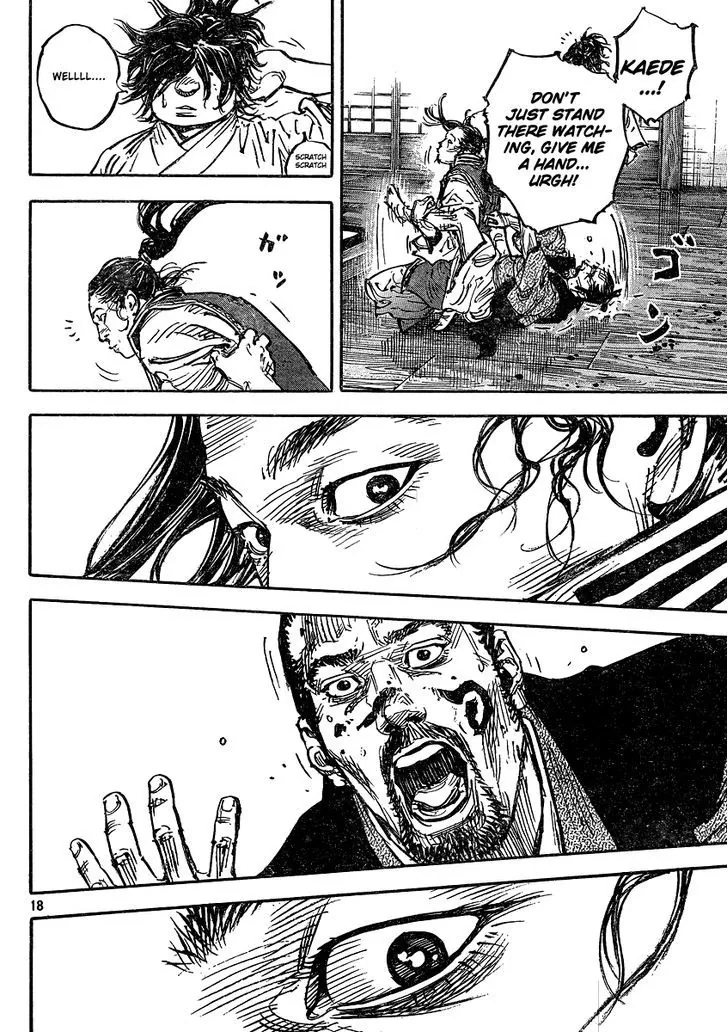
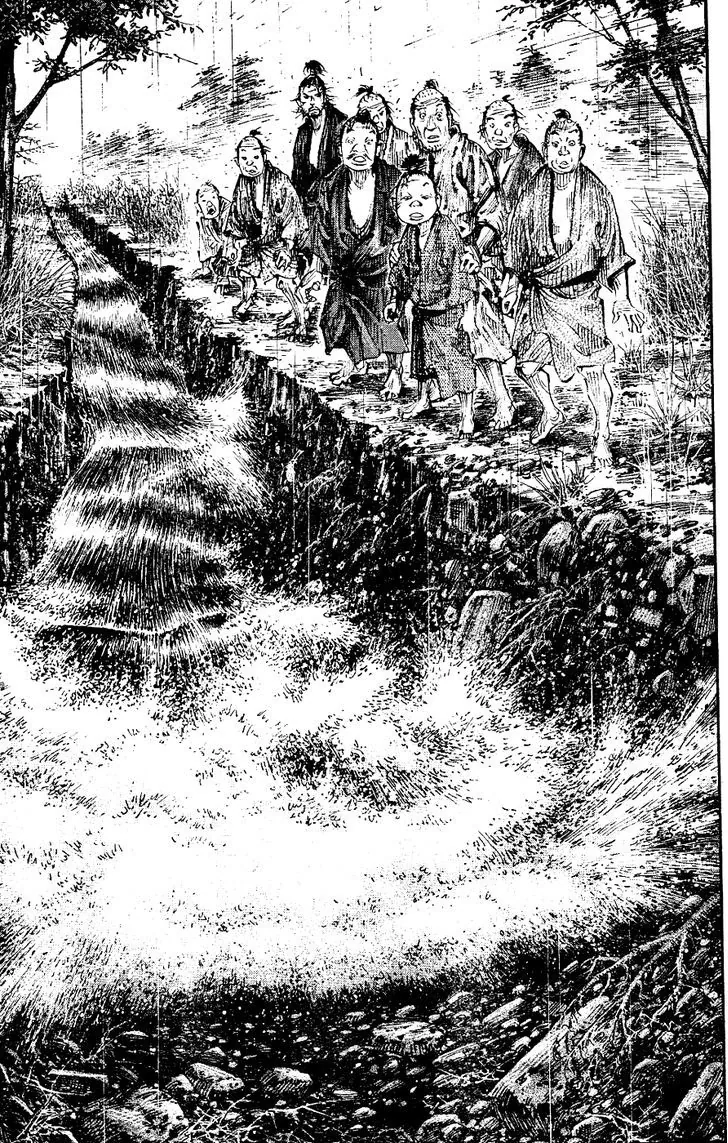
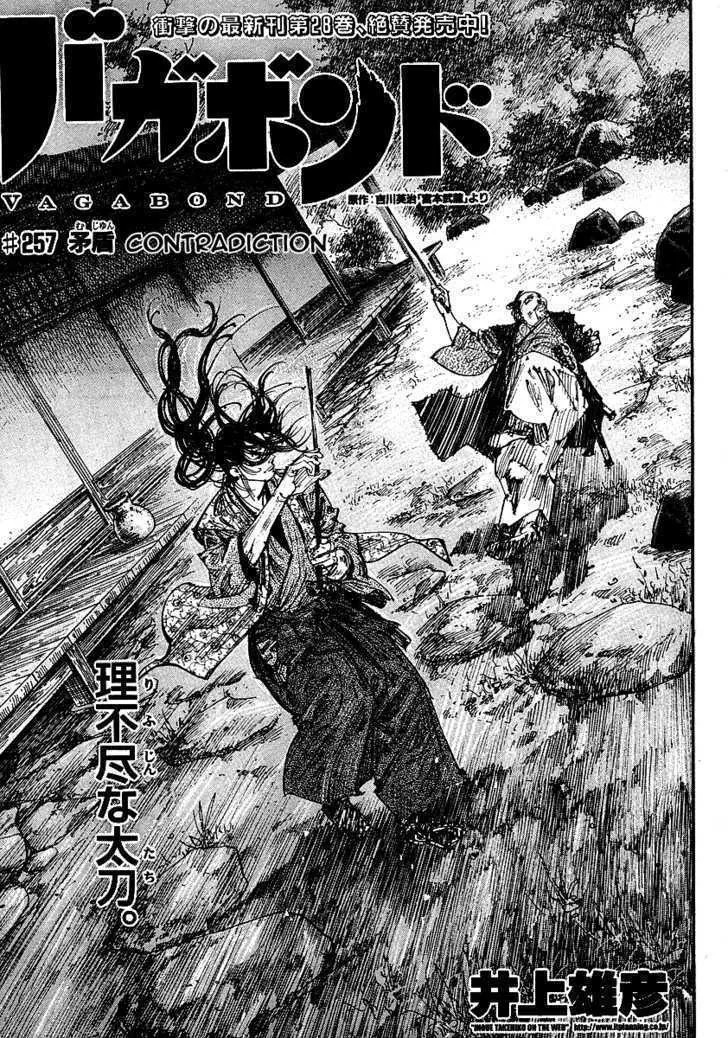
The prints sold him fighting monsters. Inoue drew a young man learning to stop fighting.
一筆 Draw the circle in one stroke: from the dot, all the way round. Or keep scrolling.
Point at a block to lift it. Choose one to ink it.
空之卷
The fifth scroll
Void
道理を得ては道理をはなれ
“Having grasped the principle, leave the principle behind.”
1643 to 1645. The road ends where the book was written.
Two roads on one map: his, in beni, and the story’s, in sumi, which went further than he did.
Utagawa Hiroshige, Higo: Gokanoshō, 1856. National Diet Library.
“Knowing what is there, you know what is not. That is the Void.”
Go Rin no Sho, the Void scroll
寛永二十年十月上旬之比、九州肥後の地岩戶山に登り
“In the first days of the tenth month of 1643, I climbed Mount Iwato in Higo.”
Now every block comes off the paper again, in the order it went on, last first.
霊巌洞 Reigandō, the Spirit Rock Cave
West of Kumamoto, in a cave on Mount Iwato, he began to write.
十月十日の夜、寅の一天に筆を取て書始むるものなり
“On the night of the tenth day of the tenth month, at the first hour of the tiger, I took up the brush and began.”
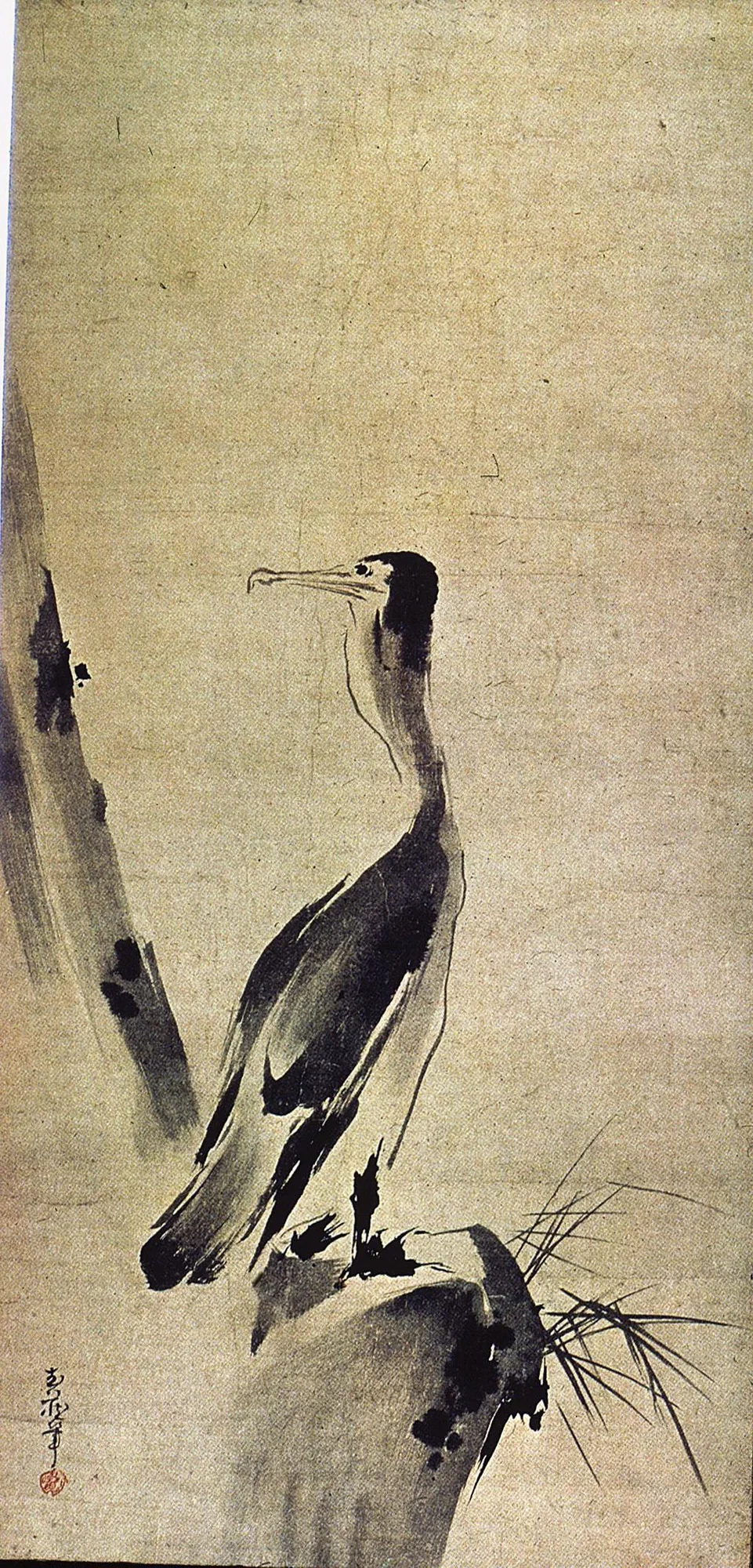
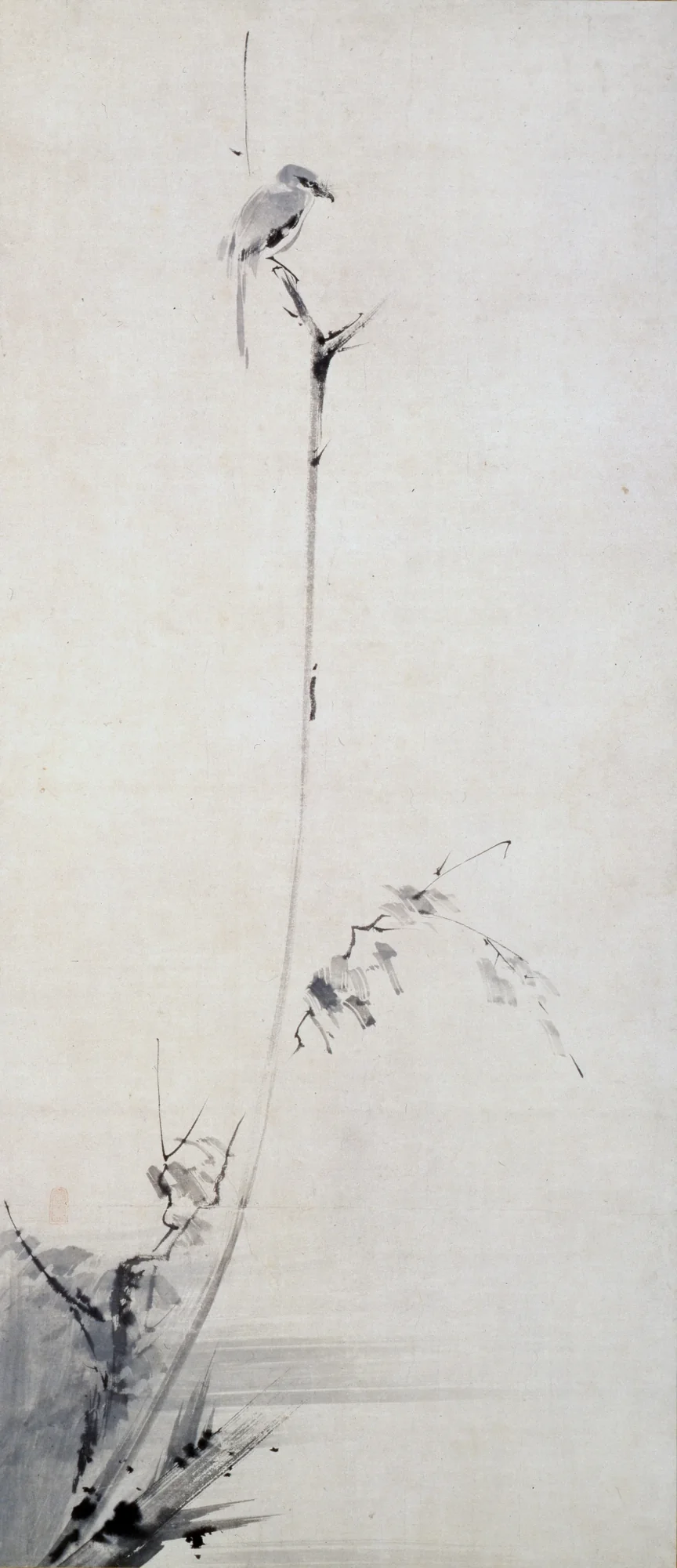
枯木鳴鵙図 He painted, too
A shrike on the tip of one dead branch. Halfway up, an inchworm, climbing.
Miyamoto Musashi, Shrike on a Withered Branch, ink on paper. Izumi City Kubosō Memorial Museum of Arts, an Important Cultural Property of Japan since 1935. Beside it, his Cormorant, Eisei Bunko.
兵法の理に任せて諸藝諸能の道となせば、萬事師道なし
“Following the principle of strategy into every art, in all things I have had no teacher.”
正保二年五月十二日
The twelfth day of the fifth month, 1645. He signs the book and gives it to his pupil Terao Magonojō.
The same week he wrote out twenty-one precepts for himself, the Dokkōdō, the Way of Walking Alone. Seven days later, on the nineteenth, he died. A note in an early copy says he asked for the book to be burned once it had been read.
新免武藏守玄信
The last line of the book
- 空有善無惡
- 知有也
- 利有也
- 道有也
- 心空也
In the Void is good, and no evil. Wisdom is. Reason is. The Way is. The mind is void.
實相圓滿
“The true form, perfectly round.” His last words, as the Kokura stele gives them.
Hire Exe.Eyes.
From one thing, know ten thousand. Bring us the one thing.
Start a project版木 The other blocks
Five more ages, carved and waiting.
His block is printed: you have just read it. Five more stand where their ages happened, carved in reverse and never inked. Choose one and pull a proof.
Azuchi戦国Sengoku 1467–1615
織田信長 Oda Nobunaga
1534–1582
Not yet printed.
奥付 The colophon
Go Rin no Sho, the Book of Five Rings. Exe.Eyes Labs, printed live in your browser.
Back to the block- 著者 The author
- Miyamoto Musashi (c. 1584–1645), 新免武藏玄信. Written at Reigandō from 1643, given to Terao Magonojō on the twelfth day of the fifth month, 1645.
- 底本 The text
- 五輪書, in Bujutsu Sōsho, Kokusho Kankōkai, 1915, National Diet Library Digital Collections (public domain). No English translation is public domain; the English here is our own plain rendering. The Kokura stele after the reading of Fukuda Masahide.
- 図版 The prints
- Ishikawa Ryūsen, Nihon kaisan chōriku zu, Edo 1691, National Diet Library. Utagawa Hiroshige, Famous Places in the Sixty-odd Provinces and Famous Places in Kyoto, National Diet Library. Utagawa Kuniyoshi, Tsukioka Yoshitoshi, Utagawa Yoshifusa: National Diet Library, British Museum, LACMA, via Wikimedia Commons. All public domain, taken apart into their blocks by Exe.Eyes Labs. The morning map: coastline from Natural Earth (public domain).
- 墨蹟 His own hand
- Shrike on a Withered Branch, Izumi City Kubosō Memorial Museum of Arts; Cormorant, Eisei Bunko; the portrait said to be by his own hand, Imperial Household Agency. Via Wikimedia Commons (public domain).
- 翻案 Vagabond
- Vagabond © Takehiko Inoue / Kodansha. A fan homage by Exe.Eyes Labs. Not affiliated.
- 音 Sound
- Original recordings made for this site: shakuhachi, o-daiko, the baren, paper, the sea, the cave.
- 工 The craft
- Every print here is separated into its colour blocks and printed again in WebGL, block by block, the way a printer pulls a sheet: the paper’s relief, the baren’s pressure and each ink’s bleed are drawn live. The one cut, the carpenter’s line and the ensō are drawn by your hand, and the closing map of Japan is set from real coastlines.
- 字 Type
- Kaisei Tokumin and Newsreader, under the SIL Open Font License.
- 版元 Printed by
- Exe.Eyes, in SYSTEM.EXE, 2026.
Exe.Eyes Labs. One thing; ten thousand.